

Architecture
From here it’s technical. One sentence: a Microsoft-Graph-shaped REST/OData v4 API in .NET 10 that fronts the Exchange Online PowerShell cmdlet surface with typed JSON.
The thesis - two ideas in balance
Section titled “The thesis - two ideas in balance”- The baseline is the cmdlet surface. Exchange Online exposes ~726 administratively-relevant PowerShell cmdlets. That is the source of truth for what can be done and what fields exist - we never invent shapes; we mirror the cmdlets, grounded against Microsoft’s own published docs.
- The shape is Microsoft Graph conventions. Entity sets, OData query options, a
/$metadataCSDL document,/$reffor relationships, alternate-key lookups, a paginated collection envelope with@odata.nextLink. If you’ve used Graph, the URLs and JSON feel familiar.
So: Graph-style where Graph has the concept; cmdlet-aligned where it does not.
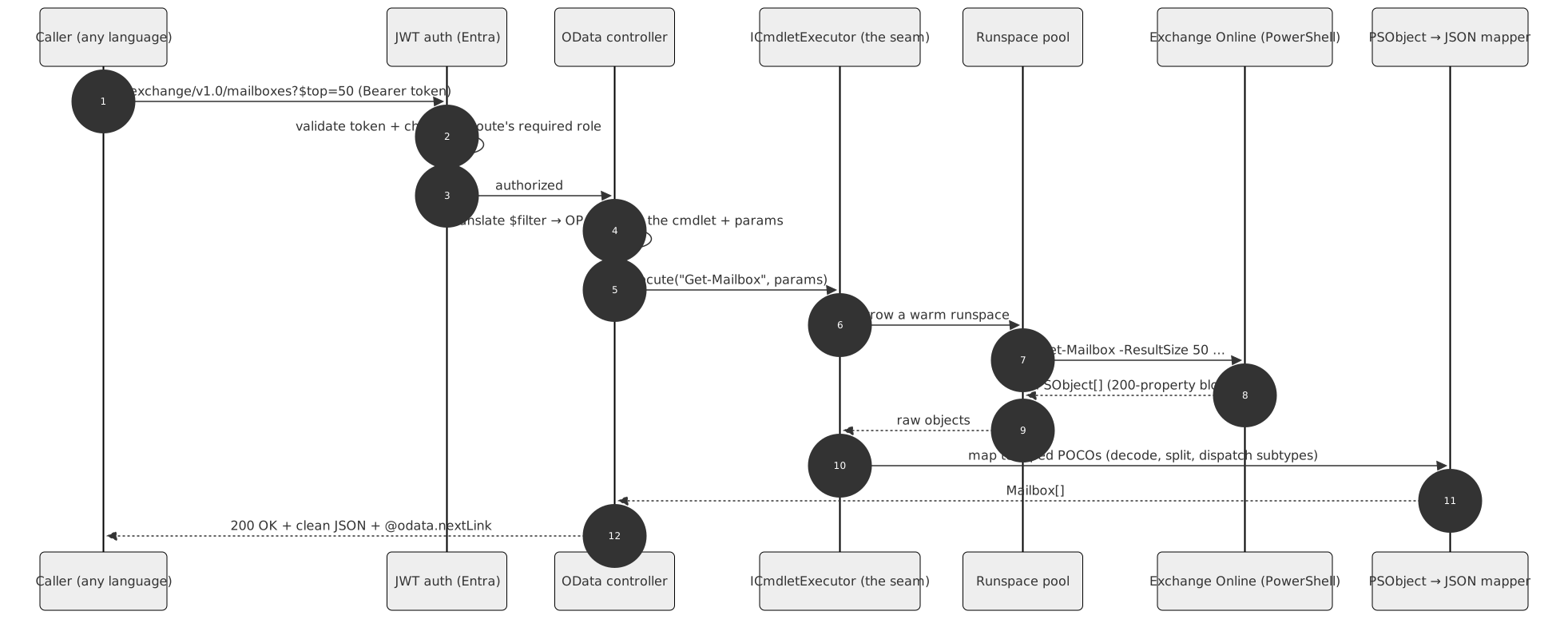
A request, end to end
Section titled “A request, end to end”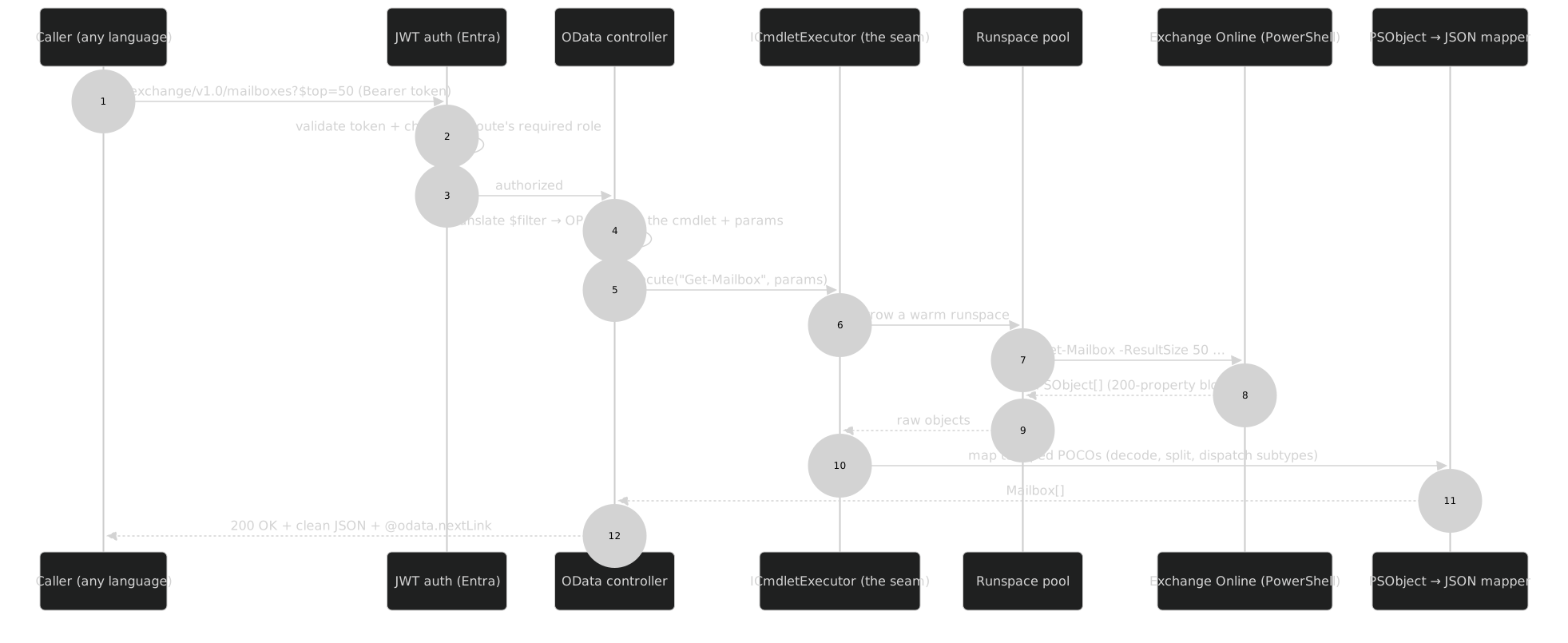
The internals - layers and the one seam that matters
Section titled “The internals - layers and the one seam that matters”

The load-bearing idea is the seam. Every controller talks to one interface, ICmdletExecutor.
In production it runs real cmdlets; in tests it returns canned data. That single abstraction is why
the whole API is testable without a tenant - and why ~5,700 automated tests can cover behaviour
that ultimately depends on PowerShell.
Why two runspace pools
Section titled “Why two runspace pools”Exchange administration is split across two PowerShell connection modes; we keep a warm, reusable pool of sessions for each so requests don’t pay a fresh sign-in every time.


Which pool a cmdlet runs in follows Microsoft’s own applicability metadata, not a guess - so a
compliance cmdlet always goes to the compliance session. The allowlist membership (V1 = EXO,
V1Ipps = IPPS) is the routing table, and the two sets are kept disjoint by a test.